
This edition of my newsletter is shorter than previous ones. Also less technical and more reflective or speculative, but I believe equally thought-provoking.
The topic I would like to discuss today is the effectiveness of continuous improvement systems in organizations. Specifically – what differentiates effective and long-lasting CI systems from those working just to “show off” or only on pure momentum after the first, top-down announcement? What factors make CI systems effectively deliver expected business results and help people, at all levels in the organization, see their value and become eager to work within them?
Looking at many industry conferences, articles, and discussions (also here, on LinkedIn) it feels like the methodology is the key. Either LEAN (especially when practised with many Japanese words and references to Japanese automakers), or DMAIC (with detailed recommendations on what to do if the distribution is not normal enough), or Theory of Constraints (with its own “bible” by Dr Goldratt), or even Project Management (with mysterious Scrum masters on the one hand and the equally mysterious Earned Value Method on the other), or any other method of working in the CI area.
Any of these approaches offers truly valuable methods which can deeply solve many business challenges and move process performance to significantly higher levels. One could (and sometimes should!) write a separate book or article about each of them – and each tool within them – as well as discuss the approach with experts and train practitioners.
What makes a Continuous Improvement system truly effective?
However, the question is whether a higher level of knowledge about a particular methodology is really something that makes the whole CI system effective from a business point of view?
I am more and more convinced that this is not the case…
Each of those methods, and each tool within them, is ultimately practised by people. And people, as human beings, make mistakes, no matter how well trained they are or how much experience they have.
- Even if they choose to make data-driven decisions (very rightfully so), the way they select data for those decisions may be a result of their assumptions, biases, or other cognitive distortions.
- Even if they choose to focus on Value-Added Activities only – translating this high-level definition into actual actions here and now may still be subject to individual and subjective interpretation.
On the other hand, most of the improvement actions identified in any improvement methodology are not rocket science. They are rather obvious, common-sense ways of doing things better. And they are in line with the natural attitude of most people: we prefer to work efficiently and effectively, not pointlessly.
I do believe that an effective CI system is one that not only takes this human factor into account, but is fully based on it.
To be more specific, I claim that the organization will benefit the most from the Continuous Improvement system if it is based on just two pillars:
Engagement
This is about ensuring that everyone in the organization will perceive involvement in the CI system as beneficial. Beneficial from a professional point of view (“my work will be more effective, more meaningful”, “my team’s results will be better, more predictable”, etc.) as well as from a personal point of view (“I will learn new skills”, “I will do something new, more interesting”, “I can use this experience in my future career”, etc.).
Of course, easier said than done, but there are plenty of tools any organization can apply here. From defining and shaping company culture around continuous improvement, through performance assessment or bonus systems, to communication and management styles, and many more.
Structures
High engagement from everybody can easily end up doing a thousand things in all possible directions, with all of them cancelling one another out in the end. Or it can cause quick burnout if the environment around a highly engaged employee does not support their passion and just puts up obstacles.
Therefore, the second pillar of an effective CI system are structures. Structures in the sense of “things” in the organization that people can use and rely on. For example:
| There are well defined ways of practicing engagement. Stuff like: – “Here you can report any idea you have for improving the situation, and we will take care of the rest (with your involvement)” – “This is how you can lead your own improvement project, where you can steer the whole work” – “We are organizing improvement workshops every month – join and help us find the best improvements” All of them well embedded as standard ways of working in the organization, easy to use, and supported by management teams at all levels. |
| There are efficient business mechanisms to decide which areas should be a priority for CI and which identified solutions are sound enough to be implemented. |
| There are appropriate support structures: some training courses, rather easy and conceptual (“pay attention to this and that”, “this concept works best in most cases”, “consider this before making a decision”, etc.), and some support mechanisms for special or difficult cases (practitioner forums, mentoring, coaching, etc.). The goal of them are not to create infallible experts on methodology X, but to allow people to engage more easily (“I know what this thing is about – let me try!”) and to increase their chance of success. Because even if some percentage of actions were suboptimal or wrong, we would still have management mechanisms to filter them out, and even if they failed – there would be many future improvements to self-correct the problematic ones. |
Long story short – I consider widespread engagement in continuous improvement and some structures facilitating this engagement as far more important than expert-level knowledge.
Would you agree?
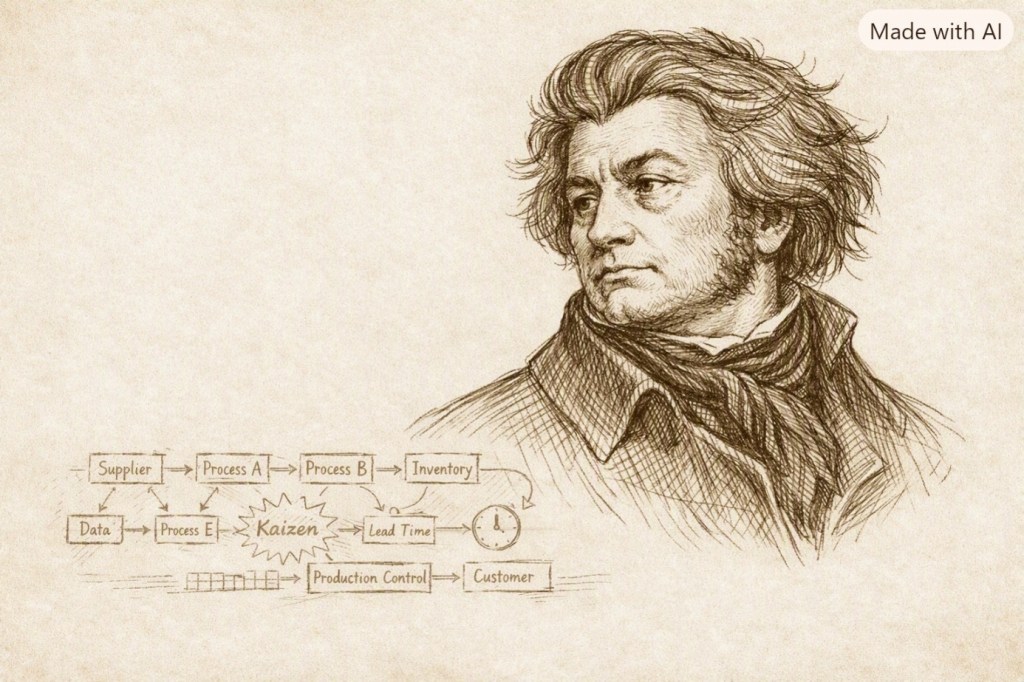
PS. For non-Polish-speaking readers – the title and visual of this article may feel strange, but they refer to a (slightly adjusted) quote from a quite famous Polish poet from the nineteenth century. I never thought I would use it one day in such a context 🙂


Leave a comment