Every process improvement to be sustainable needs to be supported by the proper training. This training can be as simple as 15 minutes instructions “on the job” or as complex as several weeks course, but in all cases needs to be carefully prepared to be effective.
Let’s take a look on high-level steps worth to be taken to achieve it:
Step 1: Analysis
In our context, this is mainly about understanding audience to be trained (typically: those whose behaviour or attitude must change as a result of the process improvements efforts). How big is the group? Where are they? Who are they? What knowledge do they have already? What languages do they speak? How much time do they have to learn?
And very important: What are their high-level training needs? Is it more about knowledge to be gained, psychomotor skills to be developed or attitude (motivation) to be improved?
Step 2: Design
Here is the place to translate high level needs into actual learning goals. What specific knowledge, skills or attitudes need to be “installed” into training audience to make them capable of acting in the new, changed environment? My recommendation is to be really specific, so for example rather “Able to identify and quantify project risks” than “Can deal with ambiguity”.
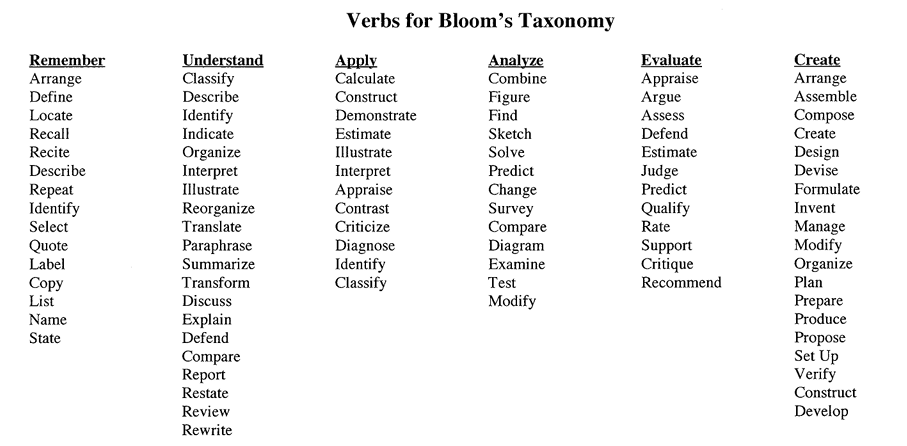
Benjamin Bloom’s classification of learning objectives can be really helpful at this step, both conceptually (what are possible “levels of proficiency”) and practically (what are verbs to be used when writing learning objectives). See below:

Other way to define “proficiency levels” required to be delivered by the training is to indicate them by some scoring system. When talking about knowledge levels I am often using 5 levels scale, starting from level 0 (“I don’t know the topic at all”) and finishing at level 4 (“I can teach others about this topic“)
Once specific learning goals (or competences to be developed) have been defined it is time to decide what is the best way to achieve them. Should it be simple lecture or practical exercise? Instructor led or self-study? Will we need examples or case studies? Videos? Chats with experts? Should it be one time event, or set of events over time, supported by coaching and feedback? One training module or series of modules in multiday course? Also, to what extend the training will help to develop required skills, and to what extend experience on the job would be needed?
Step 3: Development
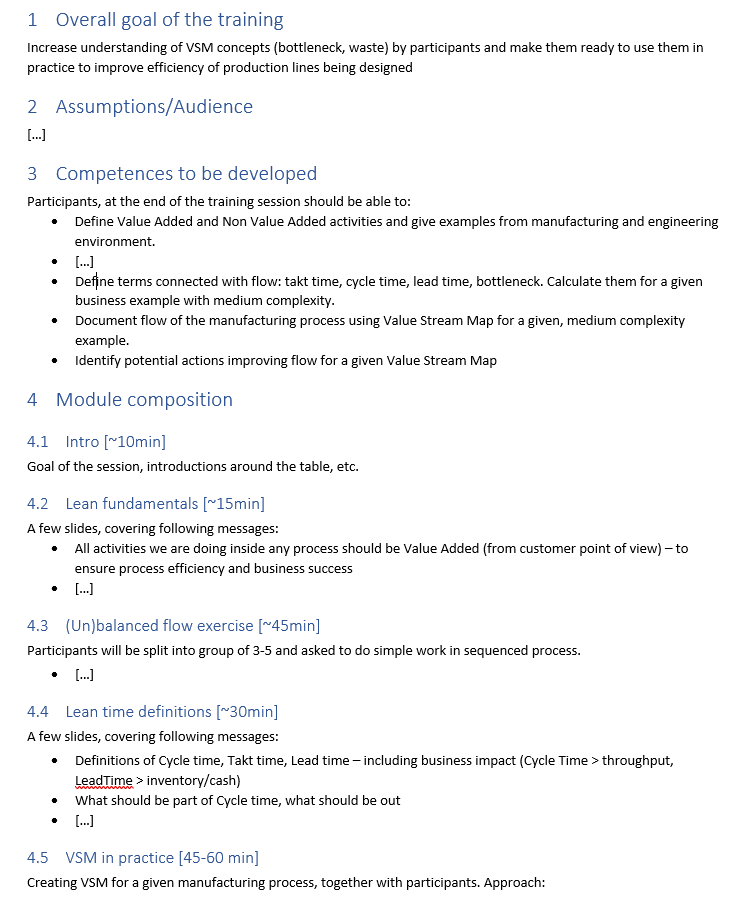
Only now we can start thinking about actual training materials: how selected way of delivery of selected competence should look like. Thinking, not preparing yet – as recommended way is to start from short document (called outline or abstract) describing how specific module should look like. It should contain learning goals, high level flow of the module, main messages to be passed, required exercises, case studies or discussions, etc.
Written outline can serve as very effective way to discuss and agree training content between team members, external experts or training requestors.
Here is example of the outline I have recently created:
Only after creating an outline it is time to work on the actual training content (for example Power Point slides, case studies, supporting materials, etc.).
Check my short article about six tips for effective presentations, as they apply to the training slides as well.
Step 4: Implementation
Completed training needs implementation, i.e. actual execution of the training course. Typical implementation procedures are valid also here: make a plan, analyse risks, consider pilots, etc.
Step 5: Evaluation
The last step is to check effectiveness of delivered training. The ultimate question we should ask in the context of process excellence is: did it make the audience ready to operate effectively in the new, changed process? The best answer to such question would be to check behaviours of the people trained (are they in line with expectations?).
This is in fact Level 3 of the Kirkpatrick Model of training evaluation – the most commonly used model in this area:
- Level 1: Reaction – The degree to which participants find the training favourable, engaging and relevant to their jobs
- Level 2: Learning – The degree to which participants acquire the intended knowledge, skills, attitude, confidence and commitment based on their participation in the training
- Level 3: Behaviour – The degree to which participants apply what they learned during training when they are back on the job
- Level 4: Results – The degree to which targeted outcomes occur as a result of the training and the support and accountability package1
However this is not easy to measure or even observe so in many situations we have to stay on Level 2 (did learning transfer occur?) or even on Level 1 (did the audience feel positive about the training?).
From my experience I would recommend trying something between level 1 and 2: ask the audience to self-assess their level of knowledge and skills that were intended to be developed during the training: Do you think you understand now element A? Do you see yourself ready to do activity B?
Potentially using the scale I have mentioned in the step 2 above.
ADDIE
Those five steps described above form the ADDIE model – one of best-known models to develop training courses that really works in practice.
I do recommend it!

 Process Excellence Coaching & Consulting
Leave a comment